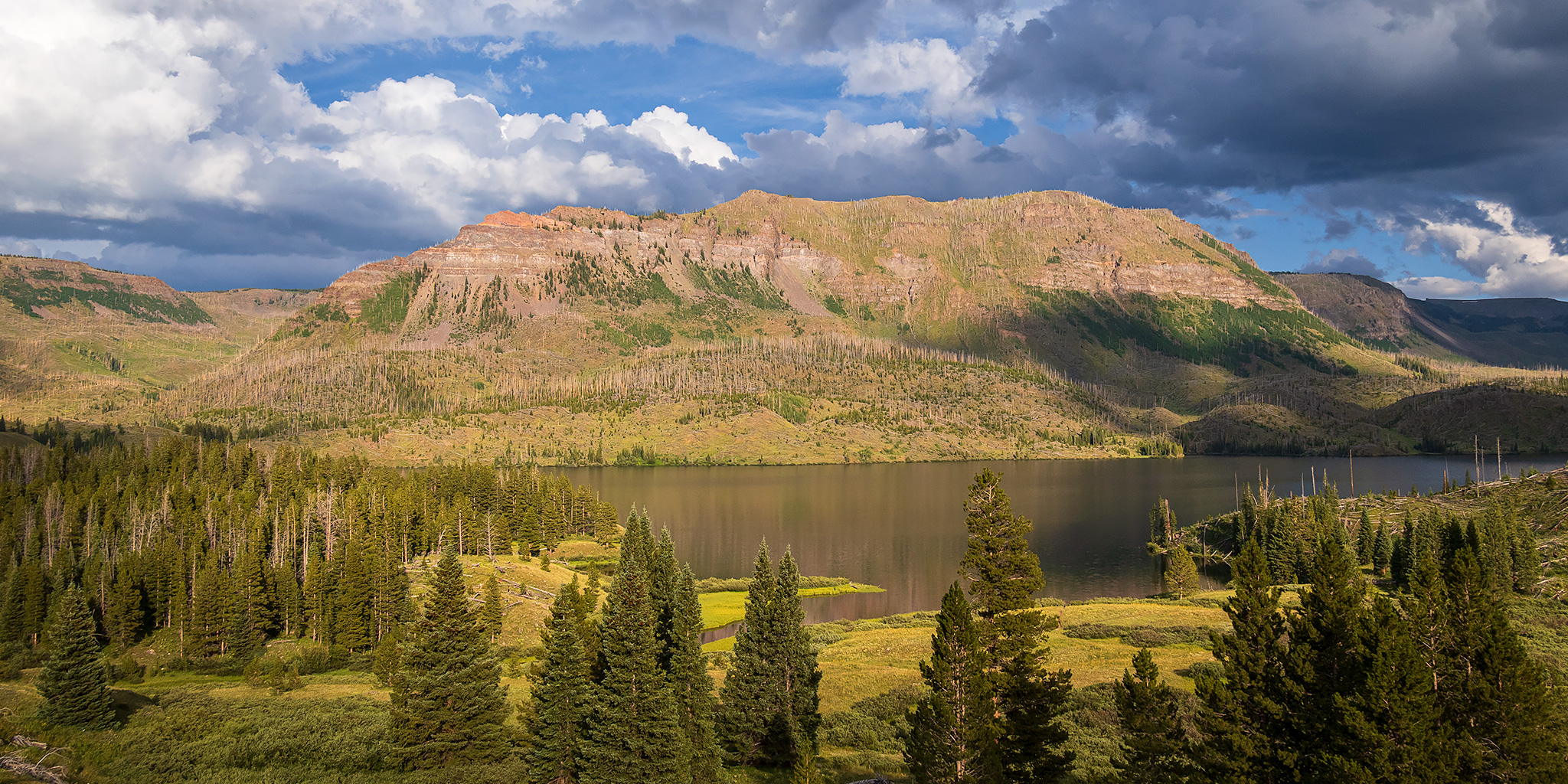
Flat Tops Wilderness | Friday – Sunday, July 18-20, 2025
Perhaps the rebuilding of the body and spirit is the greatest service derivable from our forests, for what worth are material things if we lose the character and quality of people that are the soul of America.
– Arthur Carhart, 1919
This weekend I set out to finish what I had hoped to accomplish during the last weekend in June by heading up into the Flat Tops Wilderness to hike a few of the trails that surround Trappers Lake in this ‘Cradle of Wilderness.’ I had actually planned to go on this trip late last month but during the drive between Rifle and Meeker I had some issues with my Jeep and ended up having to return home, which not only ruined my weekend plans but was also the last straw with my Jeep and part of the reason I am now driving a 4Runner. This time I left after work on Friday and had no issues with the drive to Trappers Lake. Since all my hiking was planned around Trappers Lake and dispersed camping is not allowed in the immediate area, I grabbed an open campsite at the Himes Peak Campground which is right along the North Fork of the White River and only a few of the sites were occupied, which was nice. With my campsite secured for the weekend I continued down the road to the Scotts Lake Trailhead and hiked down to the shore of Trappers Lake.
There was a nice view over Scotts Lake as I made my way to the edge of Trappers Lake.

Welcome to the Flat Tops Wilderness.

I followed the shore out to the end of a little peninsula that juts out into Trappers Lake.

Trappers Lake is known as the “Cradle of Wilderness” because of the efforts of Arthur Carhart, a landscape architect with the US Forest Service who began advocating for protection of the area in 1919. Based on Carhart’s surveying report, the Forest Service abandoned its plans for developing the area and prohibited future development. This made Trappers Lake the nation’s first unofficial “wilderness area.” After the Wilderness Act of 1964 allowed for the creation of development-free natural areas, Trappers Lake was included in the Flat Tops Wilderness Area designated in 1975.

There were still a few nice patches of wildflowers found here.

Trappers Lake Wildflowers

After the hike along the shore I drove over to the Trappers Lake Overlook to check out the view.

Trappers Lake Overlook

Then I returned to the Outlet Trail and followed it to the shore of Trappers Lake for a different perspective.

On my way back to the campground I stopped for one last short hike to the Lake of the Woods.

Lake of the Woods

This was my last look at the sun before it disappeared behind the cloudbank and would not return again this evening.

After a pretty good night of sleep, I woke up early on Saturday morning to hike a loop from camp that would take me up Big Fish Creek and then contour back below Himes Peak to Trappers Lake and then follow the North Fork of the White River back to my campsite.
Hiking up along Big Fish Creek at sunrise.

Big Fish Morning

After a few miles the sun started to illuminate the cliffs of The Flat Tops that surrounded me.

There were some nice reflections when I reached Big Fish Lake.


I watched this beaver for a while that was swimming in circles and ruining the reflections.

After enjoying the views at Big Fish Lake I continued upstream along the creek as I hiked higher into the valley.

Big Fish View

Eventually I reached the junction with the Himes Creek Trail, took a left, and started following it towards Florence Lake.

It wasn’t long until Florence Lake came into view.

The trail dropped down near Florence Lake and continued on around the northern end of Himes Peak.

Hiking below Himes Peak.

Himes Peak & Wildflowers

The trail followed the Shepherds Rim back to Trappers Lake.

Himes Peak Trail

When I reached the trailhead near Trappers Lake I turned onto the Duck Lake Trail which according to the map would take me back to the Trappers Lake Road about two miles from camp. Although the first mile or so of the trail was easy enough to follow, after that it got hard to follow and completely disappeared in a few places- but with some route-finding, a little bushwhacking, and getting my feet wet in a creek crossing, I was eventually able to make it back to the road. This is certainly a trail that does not see much use these days.
Duck Lake Trail View

There was a nice overlook of the Lake of the Woods along the way.

Once I reached the road, I followed it the rest of the way back to camp. It was all downhill, so it was an easy and fast walk even though my legs were getting a bit tired by now.

After resting in camp for a while I returned to the Trappers Lake Overlook later in the evening and hiked down the Scotts Bay Trail.

Scotts Bay

The Flat Tops

I returned to camp, read for a while and then went to bed early. It had been a long day and I was tired.

On Sunday morning I was up early again so I could hike the Arthur H. Carhart Trail that encircles Trappers Lake before heading back home. I drove over to the Outlet Trailhead and started the loop in a clockwise direction at dawn.
Trappers Lake at Dawn

I left the loop on a little detour to visit Coffin Lake and Little Trappers Lake as the sun came up.

Little Trappers Lake

On the way back down from Little Trappers Like I spotted this deer bedded down just off the trail.

Amphitheatre Point Reflection

After hiking around the southern end of the lake I had a much closer view of Amphitheatre Point.

There was a nice reflection of Himes Peak as I hiked past Scotts Lake.

There was a little more smoke in the air this morning which made for some hazy views.

Crossing the Outlet Bridge shortly before returning to the trailhead.

Marmot On A Rock

Leaving Trappers Lake on the Outlet Trail. It was another nice weekend exploring the trails of the Flat Tops Wilderness!

The problem spoken of in this conversation was, how far shall the Forest Service carry or allow to be carried man-made improvements in scenic territories, and whether there is not a definite point where all such developments, with the exception of perhaps lines of travel and necessary sign boards, shall stop. The Forest Service, it seems to me, is obligated to make the greatest return from the total forests to the people of the nation that is possible. This, the Service has endeavored to do in the case of timber utilization, grazing, watershed protection and other activities. There is, however, a great wealth of recreational facilities and scenic values within the forests which have not been so utilized, and at the present time the Service is face to face with a question of big policies, big plans and big utilization for these values and areas.
– Arthur Carhart, 1919
A nice bit of tranquility! I’m wondering about all the dead trees- fire, or beetles? The quote that you finish with is just as applicable today, especially here in Alberta.
All the dead trees are from the Big Fish Fire of 2002:
In mid-August 2002, a lightning strike ignited the Big Fish Fire, which swept through the Trappers Lake area and burned nearly 10 percent of the Flat Tops Wilderness. The fire destroyed eight cabins and the original Trappers Lake Lodge, with the building’s stone chimney the only remaining evidence of the eighty-year-old structure.